The Geopolitics of Semiconductors
2023-04-02
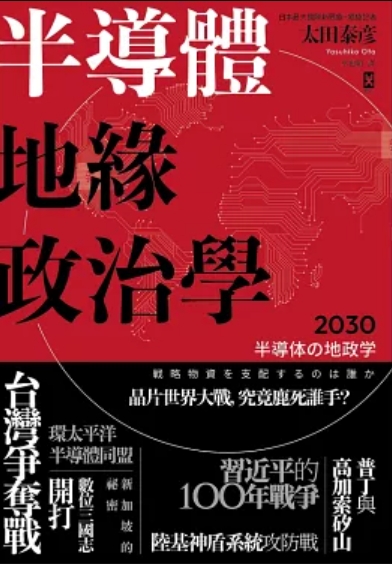
The original Japanese title is 2030 半導体の地政学:戦略物資を支配するのは誰か. One passage in the book reads:
Recall Bismarck of the Kingdom of Prussia in the 19th century: "Iron makes the nation" — a reflection of an era when steel was the symbol of national power. Today, a single car requires at least 30–100 chips, to say nothing of the phones, tablets, and computers we use every day. A nation's semiconductor capabilities are now equivalent to its military strength — encompassing weapons and defense communications.
What makes this book fascinating is its use of a geopolitical lens to analyze the semiconductor industry's role in international politics: how Japan, South Korea, and Taiwan navigate between the US and China, and how semiconductor companies today weigh political strategy alongside business development.
The author, Yasuhiko Ota, is an editorial board member at Nikkei. He joined Nikkei in 1985, studied at MIT, and has been posted to Washington, Germany, and Singapore, covering trade, diplomacy, technology, and international finance. In 2017, his reporting on China's Belt and Road Initiative won the Vaughn-Ueda International Journalist Award, Japan's largest international journalism prize.
Reading this book made me notice something about Taiwanese media: coverage tends to be overly populist and political, simplifying events and using binary framing — two countries in conflict, two parties at war — to provoke emotional reactions rather than provide real analysis.
The book never feels heavy-handed. Reading it felt more like a gripping martial arts novel than a policy text. I'm genuinely glad I found it. This reading note records the ideas I wanted to explore further — all formatted as lists. If you're interested in this topic, the author's writing is excellent, and the translator Cho Hui-juan deserves special praise: the entire translation reads naturally, with none of the awkward sentence structures common in Japanese-to-Chinese translations.
Why am I interested in semiconductors?
Semiconductors are in everything. No electronic device functions without chips. The industry also makes up a significant share of Taiwan's GDP. Some questions that surfaced while reading:
- Semiconductor progress accelerated through horizontal specialization and globalization in recent decades — but post-2020, countries seem to want to reverse that?
- Huawei was supposedly strangled — so why does it seem to be coming back?
- Why would Xi Jinping abandon software to fund the National Integrated Circuit Industry Investment Fund and double down on semiconductor manufacturing?
Reading this book gave me some partial answers. Everything is still unfolding, and while I can't participate in the industry directly, I can participate through investing — deepening my understanding of the companies I hold by reading more about semiconductors.
I'd invested in semiconductor-related companies for over two years, but my understanding was drawn entirely from news and the internet — honestly, I always had a "fog of war" feeling. That changed when I stumbled upon the semiconductor exhibition donated by TSMC to the National Museum of Natural Science in Taichung. Designed to be accessible to children, it uses clear graphics to explain the full semiconductor manufacturing process — how chips (ICs) are applied, and the entire supply chain from wafer to integrated circuit. If you've felt the same frustration of wanting to understand this space but not knowing where to start, this exhibition is worth visiting.
Semiconductor Fundamentals
-
Why does computing power need to keep growing?
If all devices must eventually transmit data to remote data centers through the cloud, companies can't provide real-time, responsive services. Mobile devices (phones, tablets, wearables) need onboard computing power, requiring high-efficiency logic semiconductors. Data centers need high-performance memory semiconductors. This is the edge computing architecture.
-
What is a nanometer?
We hear "X nanometers" constantly, but comparing it to everyday objects reveals how extraordinary this technology is. A strand of hair is 200,000 nm wide. Viruses are 10–100 nm. DNA is approximately 2.5 nm. Mature process nodes: 7–16–28 nm and above. Advanced process nodes: 5–3–2 nm. Smaller nodes generally mean faster transmission, but not every application needs high-density transistors. While smartphones, tablets, and computers require 7 nm and below, many automotive components, consumer electronics, and toys use 28 nm processes.
-
ICs classified by function — three main categories:
- Memory IC: storage, e.g. DRAM, SRAM, NAND Flash
- Micro Component IC
- Analog IC: processes continuous linear signals — light, speed, sound — including power management ICs, audio/video amplifiers, ADCs, and video ICs; talent pipeline and product cycles are longer than logic ICs
- Logic IC: performs logical computation — CPUs, GPUs, communications ICs, networking ICs; gross margins significantly higher than analog IC manufacturers, creating more competition
-
Three semiconductor business models: IDM, Fabless, Foundry
- IDM (Integrated Device Manufacturer): handles design, manufacturing, packaging, testing, and sales in-house
- Fabless: focuses on IC design and sales; no fab
- Foundry: focuses on manufacturing, taking orders from other companies
-
Automotive semiconductors use third-generation semiconductors — silicon carbide (SiC)
Compared to single-crystal silicon, SiC offers two advantages that reduce cost and vehicle weight while addressing limited driving range:
- Lower electrical resistance reduces transmission loss, allowing EV batteries to use energy more efficiently
- Doesn't generate heat from high resistance, reducing the cost and complexity of thermal management systems
Tesla and major traditional and EV manufacturers have been aggressively adopting SiC chips in recent years.
-
IC Insights, a major semiconductor analysis firm, permanently closed in December 2022.
Key Players
The book organizes players by country; I've reorganized by position in the supply chain. In the early days, a single semiconductor company handled everything — but over the past thirty years, Morris Chang's concept of horizontal specialization — design, manufacturing, packaging/testing — has become the model. His view was that this effectively reduces equipment investment burden and operational risk.
Key Research & Development Institutions
- 🇸🇬 EDB (Economic Development Board): Singapore's government agency for attracting foreign companies
- 🇧🇪 IMEC: Belgian nanoelectronics research center
- 🇯🇵🇹🇼 d.lab/RaaS: semiconductor research collaboration between University of Tokyo and TSMC
Equipment Manufacturers
- 🇳🇱 ASML: world's largest EUV lithography equipment supplier; 100% market share for sub-14nm processes
- 🇺🇸 Applied Materials (AMAT): world's largest semiconductor equipment and services supplier
- 🇯🇵 Tokyo Electron (TEL): Japan's largest equipment manufacturer
- 🇺🇸 Lam Research: dominates thin film deposition, etching, photoresist removal, and wafer cleaning
- 🇺🇸 KLA: world's largest process control equipment manufacturer
Intellectual Property (IP)
- 🇬🇧 ARM: circuit design patents plus the instruction set architecture (the "ARM architecture")
Wafer Manufacturing (IDM)
Ranked by market cap:
- 🇰🇷 Samsung: DRAM (~43% global share), NAND Flash (~33% global share), foundry
- 🇰🇷 SK Hynix: DRAM and SDRAM
- 🇺🇸 Intel: CPU, GPU, FPGA
IC Design (Fabless)
- 🇺🇸 AMD: primarily CPU and GPU design and sales
- 🇺🇸 NVIDIA: primarily GPU design and sales
- 🇺🇸 Qualcomm: primarily mobile communications IC design and sales
- 🇹🇼 MediaTek: mobile communications IC design
IC Manufacturing — Foundry
2022 global market share ranking:
- 🇹🇼 TSMC: ~60% global market share, world's largest pure-play foundry
- 🇰🇷 Samsung: ~17%
- 🇹🇼 UMC: Taiwan's second-largest foundry, focused on mature processes
- 🇺🇸 GlobalFoundries (GF): largest US foundry
- 🇨🇳 SMIC: state-backed; no design, only mature-process manufacturing
IC Packaging & Testing (OSAT)
2022 global market share ranking:
- 🇹🇼 ASE Group
- 🇺🇸🇰🇷 Amkor
- 🇨🇳 JCET
- 🇹🇼 Powertech Technology
America's Fragile Supply Chain
The US has many chip design companies, but in terms of manufacturing, 2020 foundry market share was: TSMC 59.4%, Samsung 13.05% — over 70% of wafer foundry capacity outside the US. Backend processes (dicing, packaging, testing) are virtually nonexistent domestically. This is why the US wants TSMC to bring not just fabs but also backend processes, materials suppliers, and equipment maintenance companies to establish a complete domestic supply chain.
In May 2020, TSMC announced plans to build a fab in Arizona (Phoenix), targeting the most advanced 5nm process by 2024. Three incentives used to attract them:
- Massive subsidies: up to USD 12 billion
- Strong market: 60% of TSMC's revenue comes from US companies
- Political considerations
Why the US is Sanctioning China — Root Causes and Timeline
- 2018 global 5G base station market share: 🇨🇳 Huawei 34%, 🇸🇪 Ericsson 24%, 🇫🇮 Nokia 19%, 🇨🇳 ZTE 10%, 🇰🇷 Samsung 8%
- December 2019: Canadian police arrested Huawei CFO Meng Wanzhou at Vancouver airport in transit, at the request of the US DOJ.
- 2022: TSMC banned from supplying advanced-process chips to Huawei (including HiSilicon)
The Cold War Fossil Trump Unearthed
This chapter was fascinating — I never expected to read about a law being "excavated" like an artifact. Whatever one thinks of Trump, his attempt to reconstruct trade policy was arguably necessary for the US. He reversed a post-Cold War free-trade consensus and shifted toward trade protection, escalating national security policy.
The US "Trade Expansion Act" was enacted under Kennedy in 1962 — before computers existed. Section 232, its so-called national security clause, is just one page of text. Section 232's logic is verbose and vague; it never defines "national security." But it's extraordinarily powerful — as long as the US government determines that something "poses a threat to US national security," it can trigger forceful trade intervention.
The Semiconductor Business Cycle
The semiconductor industry can be divided into three customer segments:
- Design: chip designers like Nvidia, AMD
- Manufacturing: equipment, materials, front and backend processes — TSMC, ASE
- End users: consumer-facing companies like Apple, Tesla
This creates a silicon cycle of roughly four years. Causes are debated — supply chain complexity around construction timelines and costs, inventory clearance causing price collapses. In good times, downstream manufacturers want to stock up on upstream materials, but upstream suppliers resist expanding capacity (expensive equipment investment), creating supply-demand imbalances and rising prices. In bad times, production cuts ripple through the entire supply chain.
Why I invest in TSMC
The gap between TSMC and other foundries like Samsung and GlobalFoundries comes down to the 7nm process node. To increase chip density, you must shrink line width — like fitting more text on an A4 page by reducing font size. The measure of foundry difficulty is "first-pass yield," and TSMC has consistently outperformed competitors by a wide margin.
A site I use to track real-time semiconductor industry data: companiesmarketcap.com. Top 10 semiconductor companies by market cap as of April 2023:
Rank Name Market Cap Net Income My Position 1 Nvidia 692.20B 14 1% 2 TSMC 482.40B 2 12.4% 3 Samsung 324.43B 1 — 4 ASML 268.60B 9 3.8% 5 Broadcom 267.47B 3 — 6 TI 168.77B 5 — 7 AMD 157.93B 28 — 8 Qualcomm 142.25B 4 — 9 Intel 136.26B 6 — 10 AMAT 103.80B 7 — 22 MediaTek 41.37B 12 — 40 Novatek 8.67B 29 — TSMC's dominance is remarkable. The reason it's been overtaken in ranking is that TSMC's price has been sluggish while NVDA has surged. Currently evaluating whether to add exposure through options.